
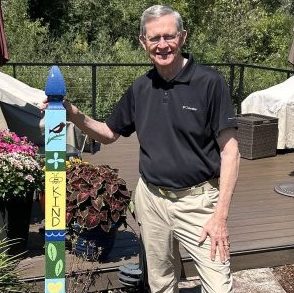
Retired elementary school principal Stan Paine is helping Eugene and Springfield build a culture of kindness
Why Kindness Matters
Retired elementary school principal Stan Paine is helping Eugene and Springfield build a culture of kindness.
Stan Paine has a habit he’s kept up for months now. Walking down a sidewalk, he’ll smile while making eye contact with someone new. Almost every time, the other person smiles back. “I love that,” he says.
Smiles and eye contact are small things. But Stan has spent his career thinking about how groups of people treat each other, and he knows small things matter.
Every school runs on a culture, which is a shared understanding—spoken or unspoken—of how people treat each other. And culture isn’t something that happens on its own.
“A culture is how we do things here,” he says. Culture is how a group sings, dances, plays, and celebrates—and how they interact with one another. “In an organization, we need to intentionally develop the values, the expectations, the practices that allow us to not just peacefully coexist, but to value one another, and one another’s strengths, and learn to get along, and even to become friends.”
In other words, a community’s culture is made of small, deliberate choices repeated over and over, and that concept has stayed with Stan into retirement.
Spreading Kindness Starts Small
This is why he has engaged in the Spreading Kindness Campaign – an initiative in his city to promote greater kindness — at home, at work and in the community. Together, participants create greater visibility to the many acts of kindness taking place such as volunteering. This effort also connects to the Kindr Foundation’s ongoing work to offer kindness-focused programs in schools, workplaces, and communities around the country.
When asked why he’s engaged, Stan said “I long for people to get along and be civil to one another.”
No matter the size of the community, each person can take small steps. For Stan, that means starting small and offering a smile. Plus, the larger campaign is a chance to do at a community level what he spent his career trying to do inside a school: make kindness an everyday, intentional part of the culture rather than the occasional nice gesture.
Stan also recognizes the win-wins that come from being kind while working across generations. Years before, he was involved in a mentoring program that paired older adults in the neighborhood with students. One woman in her late 80s became a regular mentor. When asked why, she said: “This gives me a reason to go on living.” As a volunteer, she had so much to give, but she got a lot out of it as well. “If you can find a way to do something positive for somebody else,” Stan says, “that would be a good thing to do.”
Stan returns to that story when he talks about why this work matters to him. Kindness isn’t only a gift from the person offering it. It runs both directions.
Impact Adds Up
“None of us is commissioned to save the world,” he says. “But at the same time, I think that we each need to do what we can.”
As division and distrust dominate public life, Stan’s habit of kindness is much like a bit of elementary school arithmetic: Mentor one young person and that person may go on to mentor two or three more. Each of those, in turn, might influence a few others of their own. One positive relationship becomes three, and three positive relationships become nine.
“We can each shape our culture in positive ways, in bits and pieces, moment by moment,” he says. “That seems like something worth doing.”
If you too would like to get involved in your community, start your journey with SAGE.